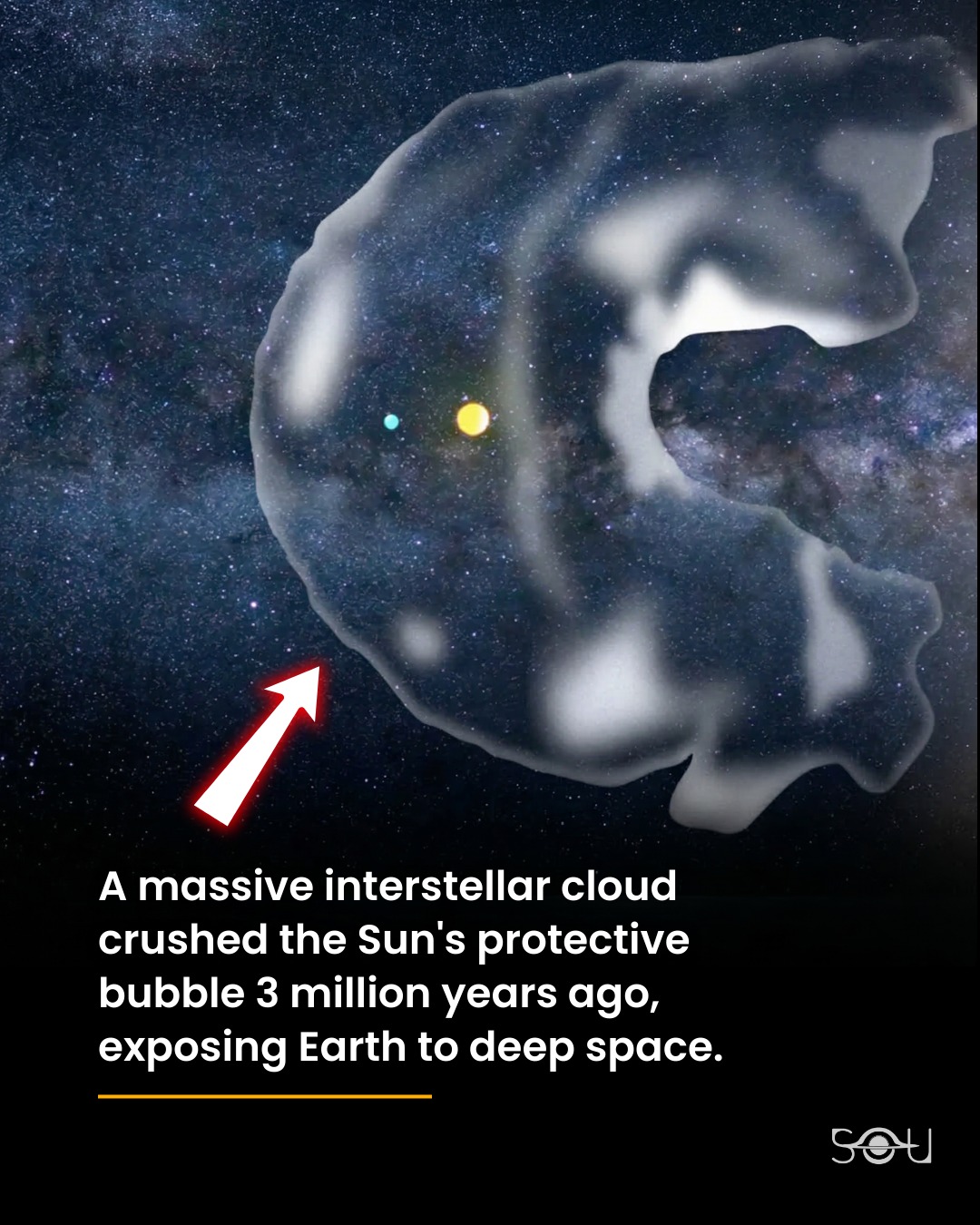
About 2 to 3 million years ago, the solar system ploughed through a massive interstellar cloud so dense that it crushed the Sun's protective bubble and left Earth directly exposed to the raw environment of interstellar space.
The Sun generates a giant plasma shield called the heliosphere, a bubble inflated by the solar wind that normally stretches well beyond Pluto and filters out cosmic radiation, galactic rays, and interstellar dust. But a team led by astrophysicist Merav Opher at Boston University used computer models to trace the Sun's path back through the galaxy and found it collided with a structure called the Local Lynx of Cold Cloud, part of a string of dense hydrogen clouds known as the Local Ribbon of Cold Clouds.
This cloud was so massive that its pressure shrank the heliosphere down to just 0.22 astronomical units, smaller than Earth's orbit. For a period lasting anywhere from centuries to a million years, our planet sat completely outside its cosmic shield.
Without the heliosphere's protection, Earth would have been bombarded with a far greater flux of cosmic rays and interstellar hydrogen, and showered with dust carrying radioactive isotopes like iron-60 and plutonium-244, both created by exploding stars. The timing matches perfectly with spikes of these isotopes found in ocean sediments, Antarctic ice cores, and even on the Moon.
It also lines up with a cooling period on Earth, raising the possibility that this encounter may have influenced the planet's ice ages. The team is now tracing the Sun's path even further back using data from ESA's Gaia mission, looking for other encounters that may have shaped Earth's climate and the evolution of life.
RESEARCH PAPER
Opher et al, "A possible direct exposure of the Earth to the cold dense interstellar medium 2-3 Myr ago", Nature Astronomy (2024)